
Before you migrate, know what you're actually moving.
A short readiness checklist for education providers preparing to migrate to a new LMS, so content issues, platform dependencies, and governance gaps show up before the project is underway.
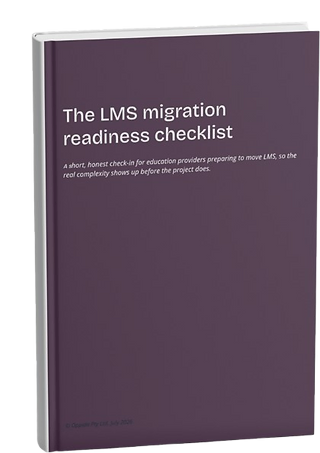
Some LMS migrations are straightforward. Many are not.
What looks like a technical transfer often turns out to involve inconsistent course structures, content that does not move cleanly, unresolved ownership decisions, and learner experience problems that have been tolerated for years.
This checklist helps you see that early. Before pricing is locked in, before timelines start slipping, and before avoidable rework gets baked into the project.
What you'll get
Four things the checklist gives you — before pricing is locked in and timelines start slipping.
A five-part checklist to review content patterns, technical dependencies, learner experience, governance, and internal capability.
A clearer sense of whether you are dealing with a genuine lift-and-shift or a migration that also needs review, redesign, or stronger project planning.
A practical way to capture what you know, what is still unclear, and what needs to be resolved before scoping begins.
An optional prompt you can use to turn your answers into a short migration brief for internal planning or an external scoping conversation.
Who it's for
This checklist is for universities, TAFEs, RTOs, private colleges, and training providers preparing to migrate to a new LMS.
It is written for the people accountable for how the move lands: digital learning leads, programme teams, academic stakeholders, LMS and operations leads, and those responsible for quality, timing, and delivery.
If you are shaping the move, influencing scope, or accountable for whether it lands well, this checklist is for you.
Why this matters before you migrate
Migration is often scoped as a platform task.
The real complexity usually sits elsewhere: in how courses are structured, what content depends on the current system, how quality will be reviewed, who makes decisions, and whether the new environment is being used to recreate old problems or improve them.
Working through those questions early gives you a clearer brief, a more realistic scope, and a better chance of avoiding rework halfway through the move.